You know the feeling.
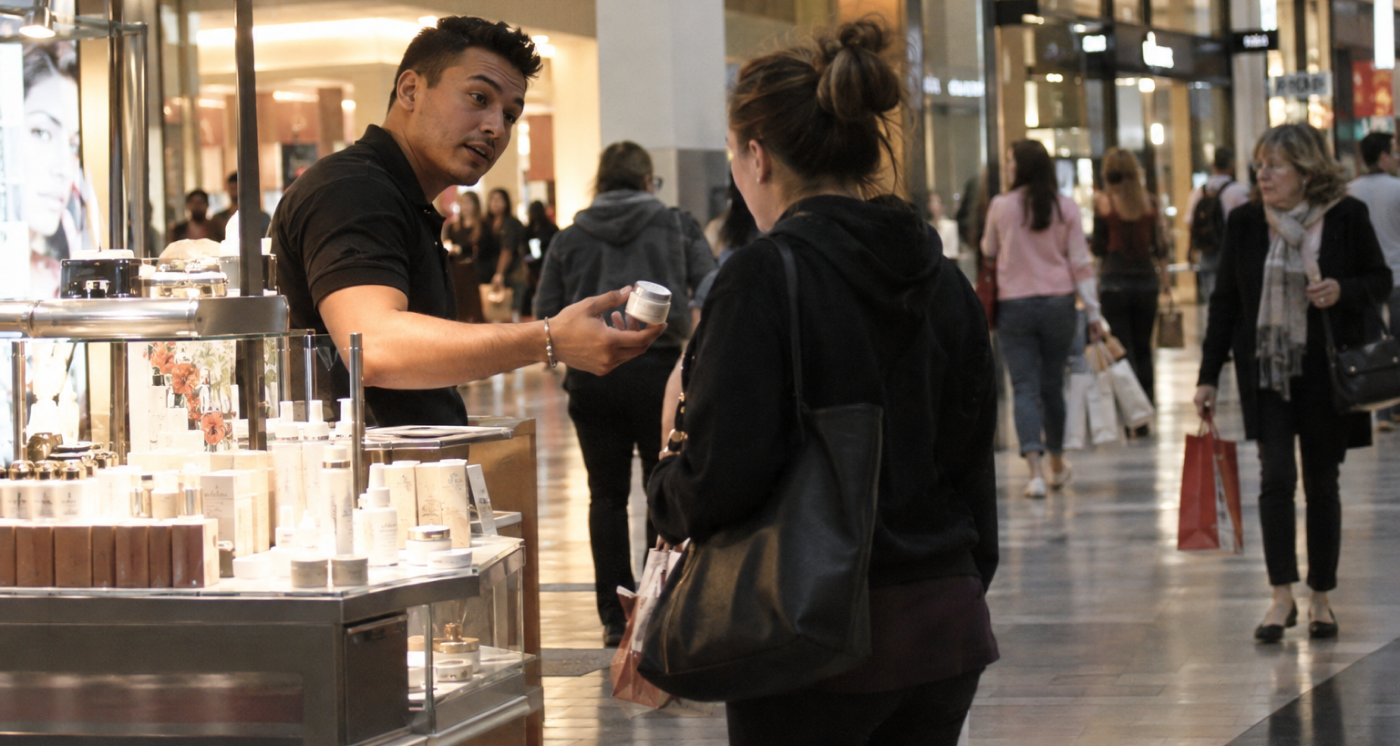
You're walking through the mall, minding your business, when you spot someone standing 30 feet ahead holding a bottle of hand cream.
You immediately look at your phone.
But it’s too late.
“Excuse me! Can I ask you a question?”
Welcome to the strange world of mall kiosk sales.
Mall kiosks have been around for decades. One of the earliest modern programs began at Boston's Faneuil Hall Marketplace in 1976, when developer The Rouse Company put pushcarts into the property. The idea spread, and by the 1990s, carts and kiosks had become fixtures in American shopping centers.
In the industry, the business is known as “specialty leasing.” Instead of signing a long-term lease for a traditional store, an entrepreneur can rent a cart, kiosk or Retail Merchandising Unit (RMU) in the middle of the mall. Agreements can be considerably shorter than traditional retail leases, which makes kiosks especially attractive to seasonal businesses and entrepreneurs testing new products.
For mall owners, it's a way to make money from common areas that otherwise generate no direct rent.
For entrepreneurs, the appeal is obvious. Opening a kiosk generally requires less capital than building out a full store. There is less inventory, fewer employees and, most importantly, thousands of potential customers walk directly past the business every day.
The catch is that the space can be surprisingly expensive.
A Mall of America specialty-leasing guide, for example, listed cart rents ranging from $2,500 to $9,900 per month depending on the season. On top of that, tenants could owe the mall 18% of sales above a specified threshold. November and December commanded the highest rents.
That helps explain the selling style.
A normal store can wait for customers to walk inside. A kiosk doesn't have an inside. If the salesperson wants prospects, they have to manufacture them from the stream of people desperately pretending not to make eye contact.
So kiosk selling evolved into an unusually pure form of cold prospecting.
Workers call out to passersby, ask questions, offer samples and demonstrations, and try to physically interrupt the prospect's journey through the mall. Products that can be demonstrated quickly—skincare, hair tools, sunglasses, phone accessories and various objects that vibrate—are particularly well suited to the format.
The products themselves can also leave plenty of room for selling.
Kiosk operators frequently source relatively inexpensive merchandise wholesale and sell it at much higher retail prices. That margin helps cover rent, labor and commissions, but it can also give salespeople enormous flexibility at the point of sale.
This is why a $150 hair straightener might suddenly become $120. Then $90. Then, because the salesperson apparently likes you more than any customer they've met all week, $70 if you buy it right now.
The negotiation is part of the pitch.
Instead of the fixed-price experience customers expect from most American retailers, some kiosks operate more like miniature bazaars. The salesperson starts high, watches the reaction and adjusts. Bundles get created. “Manager specials” materialize. The goal is to discover the price that turns a person who had absolutely no intention of buying moisturizer four minutes ago into the owner of $85 worth of moisturizer.
Compensation helps explain the intensity, too.
Pay structures vary by operator, but kiosk jobs have long been associated with commissions, bonuses and sales targets. One longtime kiosk salesperson interviewed by The Billfold said he was earning $1,000 to $1,500 during an average week, far more than he'd previously made working at Foot Locker.
For a strong salesperson, the economics can be attractive. For everyone else, standing for eight hours while being rejected by several hundred people can make cold calling from an air-conditioned office sound luxurious.
Ownership varies as well. Some kiosks are run by individual entrepreneurs, some are franchises or larger operators, and the mall itself may own the physical cart and rent it to the merchant. A successful operator can also run multiple kiosks, moving products and employees between malls and adding locations during the holiday rush.
And unlike an SDR with a list of 500 accounts, the kiosk salesperson gets a completely new pipeline every few seconds.
Mom with shopping bags: prospect. Teenager staring at phone: prospect. Guy who suddenly crosses the hallway because he sees you holding a lotion sample: difficult prospect, but still a prospect.
It is sales stripped down to its most basic elements: get someone's attention, create interest, demonstrate value, overcome objections and ask for the money—all before they make it to Auntie Anne's.
Which is why the person holding the mysterious skin serum can't afford to let you stroll past. You see an annoying person in the middle of the mall. They see an inbound lead attempting to escape.