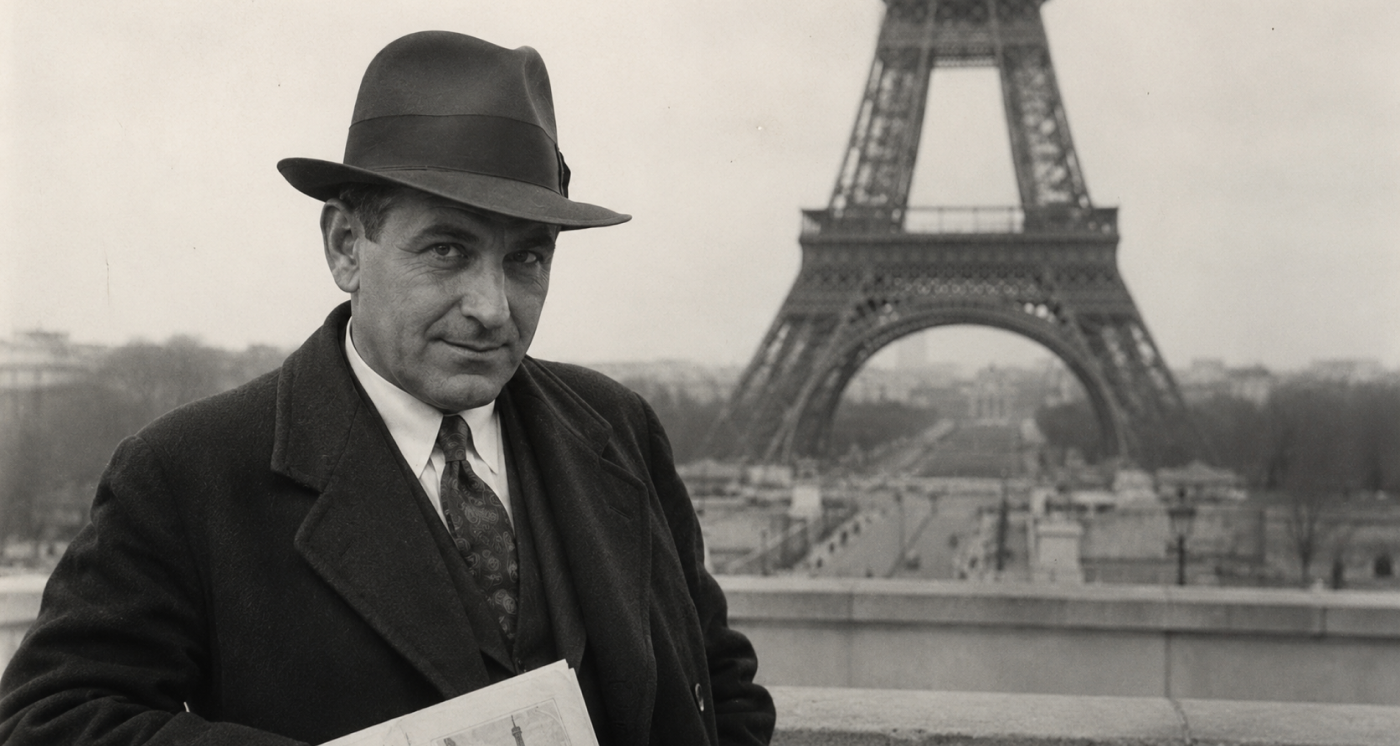
In 1925, Victor Lustig pulled off a sale that should have been impossible.
He sold the Eiffel Tower.
Lustig was already an experienced con man by the time he arrived in Paris. Born in what is now the Czech Republic in 1890, he was charming, well-dressed, spoke several languages, and had spent years running scams across Europe and aboard transatlantic ocean liners. He specialized in gaining people's confidence, often presenting himself as a wealthy businessman or aristocrat.
Then he came across an opportunity.
The Eiffel Tower had been built for the 1889 World's Fair and was originally intended to stand for only 20 years. By the 1920s, it had survived well beyond that deadline, but maintaining the enormous iron structure was expensive. According to accounts of Lustig's scheme, a newspaper article about those maintenance costs gave him an idea.
Lustig had official-looking government stationery made and posed as a deputy director in France's Ministry of Posts and Telegraphs. He contacted several prominent scrap-metal dealers and invited them to a confidential meeting at the luxurious Hôtel de Crillon in Paris.
There, Lustig delivered his pitch. The French government, he explained, had decided that maintaining the Eiffel Tower had become too expensive. The structure would be demolished and its roughly 7,000 tons of iron sold for scrap. Because officials feared a public backlash, the decision had to remain secret until a buyer was selected.
It was an audacious story, but Lustig made it believable. He met the dealers in an expensive hotel, used forged credentials, swore them to secrecy and even took them to the Eiffel Tower for an inspection.
He also studied his prospects carefully. Lustig eventually focused on André Poisson, a scrap-metal dealer who was reportedly eager to establish himself among Paris's business elite. Poisson's wife was suspicious of the deal, so Lustig added another layer to the con. He privately suggested to Poisson that, like many poorly paid government officials of the era, he expected a bribe in exchange for awarding him the contract.
The request helped convince Poisson that Lustig really was a corrupt bureaucrat.
Poisson paid for the rights to the Eiffel Tower and gave Lustig the bribe. Lustig promptly took the money and fled to Austria. Then he waited for the police to come looking for him.
But they didn't.
Poisson was apparently so embarrassed about being conned that he never reported what had happened. When Lustig realized the authorities weren't pursuing him, he did something even more outrageous. He returned to Paris and tried to sell the Eiffel Tower again.
Lustig repeated essentially the same scheme with another group of scrap dealers. This time, however, his intended victim became suspicious and contacted the police. Lustig escaped before he could be arrested.
He continued running scams afterward, eventually moving to the United States and becoming a major counterfeiter. Federal agents finally captured him in 1935, and he was later sent to Alcatraz. He died in 1947.
Nearly a century later, Lustig's Eiffel Tower scheme remains one of history's most famous cons. He had no product, no authority to make the deal, and no Eiffel Tower to sell. Yet for one extraordinary sales pitch in Paris, he convinced someone that he did.