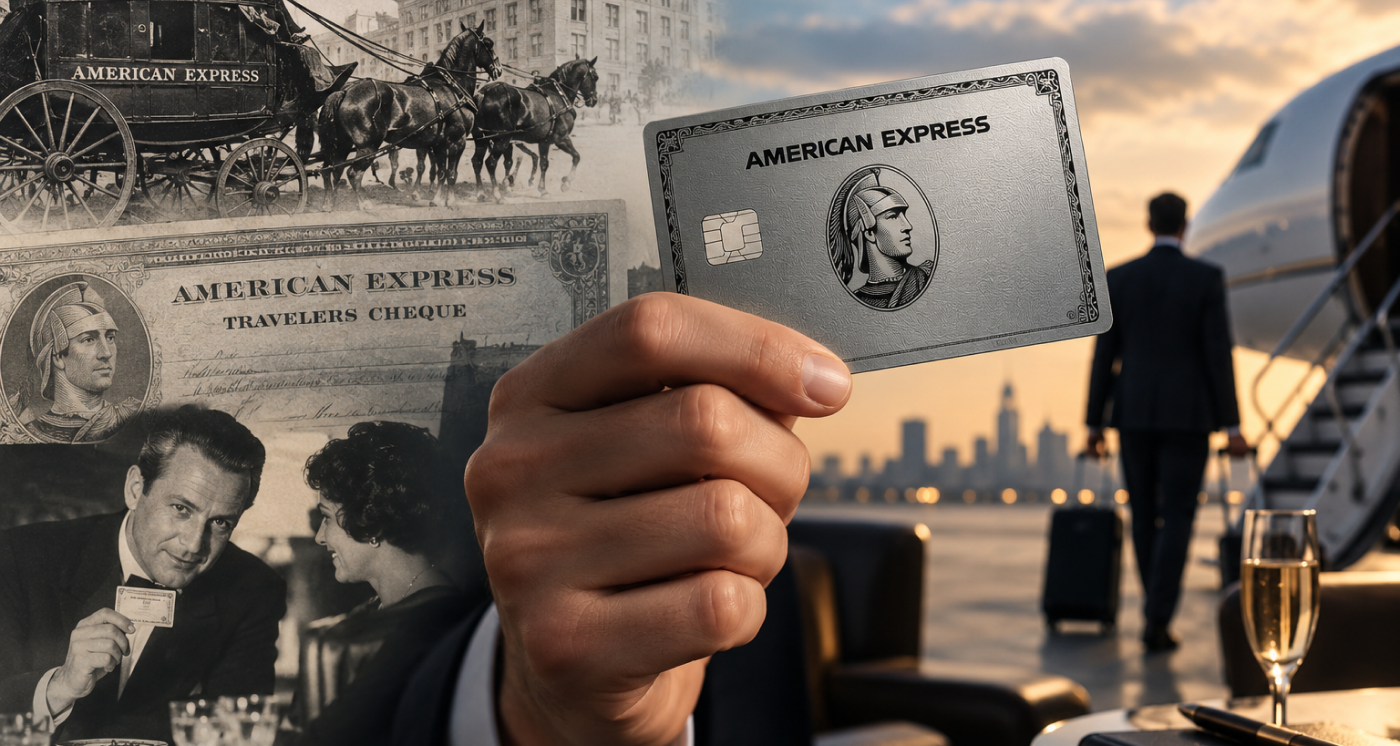
Today, pulling out an American Express Platinum Card conveys a certain message.
The card is heavy. The annual fee is high. The perks are geared toward travel, restaurants, airport lounges, and hotels. For decades, American Express has carefully cultivated the idea that carrying one of its cards means you've made it.
This is how that reputation was built.
American Express was founded in 1850 by Henry Wells, William Fargo, and John Butterfield as an express delivery business, transporting packages, valuables, and other goods around the country. As the company expanded, it moved deeper into financial services, introducing money orders in 1882 and its famous Travelers Cheques in 1891.The American Express card didn't arrive until 1958.
At the time, charge cards were still relatively new. Diners Club had introduced its card earlier in the decade, primarily for use at restaurants. American Express saw an opportunity to use its existing relationships with travelers and businesses to compete.
The first Amex cards were made of paper and carried an annual fee of $6, a dollar more than Diners Club charged. That higher price helped establish a strategy American Express would return to repeatedly: premium pricing paired with premium positioning.
Getting consumers to carry the card was only half the challenge. American Express also needed places for them to use it. That meant selling merchants.
Representatives had to persuade restaurants, hotels, retailers, and other businesses to accept a relatively unfamiliar payment method and pay American Express a fee for the privilege. The pitch centered on access to desirable customers. Amex cardholders tended to have money and travel frequently. Accepting the card could help merchants attract them and encourage them to spend more.
It created a powerful sales loop. More cardholders made Amex attractive to merchants. More participating merchants made the card more valuable to consumers.
American Express kept pushing the brand upmarket. It introduced the Gold Card in 1966 and the Platinum Card in 1984, adding benefits and exclusivity while charging increasingly substantial annual fees. Advertising reinforced the message.
Its famous "Do You Know Me?" campaign featured recognizable figures whose names might not immediately be known to viewers. Karl Malden later became closely associated with American Express Travelers Cheques and the memorable warning, "Don't leave home without them." Eventually, the slogan became associated with the broader Amex brand.
Even the company's terminology helped. Customers became "Card Members," making ownership sound like admission to an exclusive club.
In 1999, American Express pushed the concept even further with the invitation-only Centurion Card, commonly known as the Black Card. The card quickly became a pop-culture symbol of wealth, appearing in songs, movies, and celebrity stories.
More than 65 years after launching its first card, American Express is still using essentially the same flywheel. It sells consumers on the benefits and prestige of membership while selling businesses on access to those consumers.
For salespeople, there's a useful lesson buried in that history. A higher price can become part of the pitch when customers understand what they receive in return. And when a product connects two groups of customers, selling one side can make the other side easier to sell.
American Express spent decades making each new Card Member a little more valuable to every merchant—and each new merchant a little more valuable to every Card Member. That's one hell of a sales engine.