Today, buying a diamond engagement ring can feel like a tradition that has existed forever.
De Beers had a lot to do with making it feel that way.
By the late 1930s, the diamond business had a problem. The Great Depression had crushed demand, and diamonds remained an expensive purchase with little practical purpose. De Beers, which dominated the diamond trade, hired Philadelphia advertising agency N.W. Ayer in 1938 to increase demand in the United States.
The assignment was unusual because De Beers wasn't primarily trying to convince consumers to buy its particular brand. Rather, it wanted to convince millions of people that diamonds themselves were an essential part of getting married.
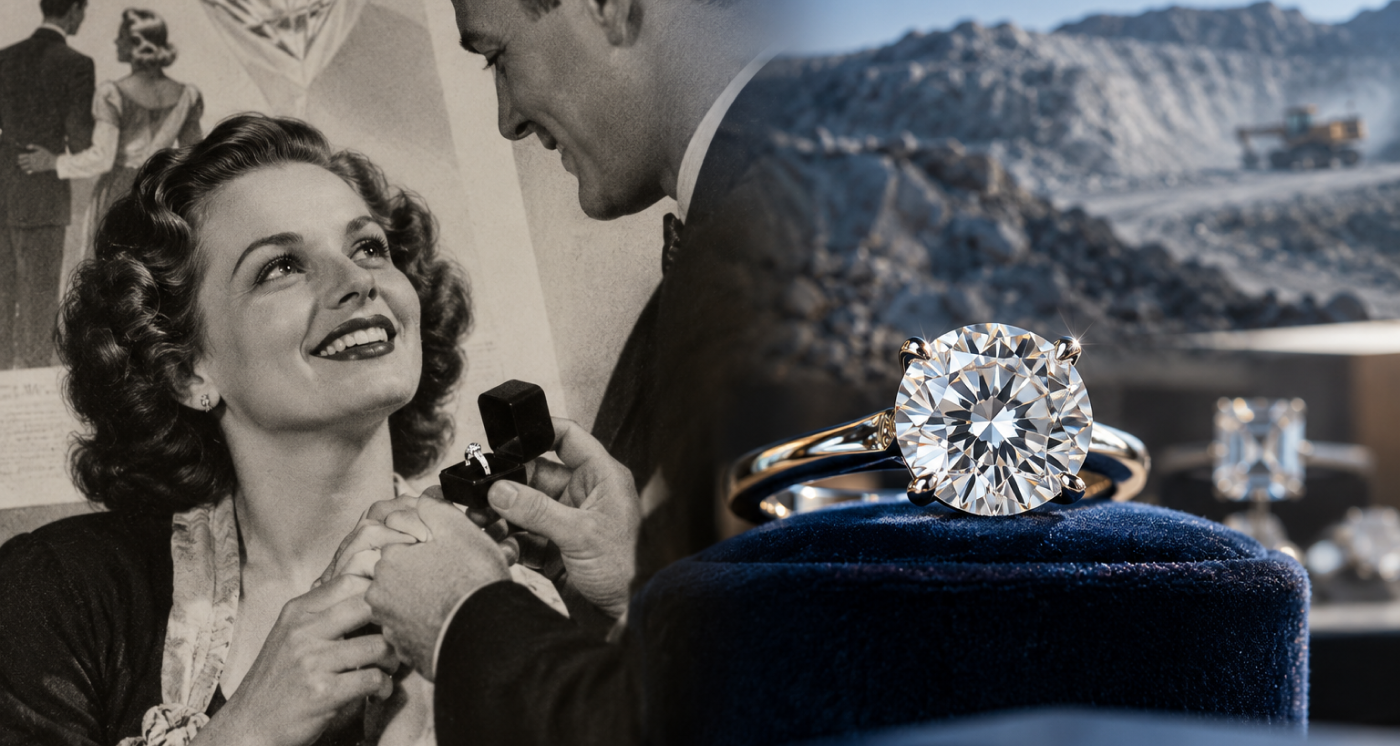
The campaign connected diamonds with romance, commitment and status. Advertisements appeared in major magazines. Celebrities and Hollywood helped associate diamonds with glamorous relationships. The agency also worked to reinforce the idea that a diamond engagement ring was an established tradition, even though the custom was far less universal than it would eventually become.
From a sales perspective, the strategy was brilliant: attach the product to an emotional event where the buyer already feels enormous pressure to make the right decision. Then came the line that helped cement everything.
In 1947, N.W. Ayer copywriter Frances Gerety wrote, “A Diamond Is Forever.” De Beers began using it the following year. The message tied the physical durability of a diamond to the permanence of marriage. By 1951, according to reporting based on the agency's records, jewelers were saying that a woman wasn't truly engaged without a diamond ring, and eight out of ten American brides were receiving one.
After that, De Beers kept finding new ways to sell the category. When smaller diamonds needed a market, advertising emphasized that size wasn't everything. Anniversary and eternity jewelry created additional reasons to buy diamonds after marriage. In Japan, De Beers began heavily marketing diamond engagement rings in the late 1960s. Within roughly 15 years, diamond rings went from a rarity among Japanese brides to a mainstream wedding custom.
The company also helped popularize another powerful sales anchor: tying the appropriate price of an engagement ring to a man's salary. Ads eventually promoted the idea that roughly two months' salary was an appropriate amount to spend.
That gave jewelry salespeople something extremely valuable: a benchmark. Instead of asking, “How much do you want to spend on a rock?” the industry could sell against an accepted social expectation.
But nearly 80 years later, De Beers is facing a very different sales challenge.
Lab-grown diamonds are chemically diamonds and can be dramatically cheaper. Their growth has put particular pressure on lower-priced natural stones, and De Beers acknowledged in its 2025 results that shifting consumer preferences toward lab-grown diamonds contributed to a $2.3 billion impairment of its value. Anglo American, De Beers' majority owner, is also in the process of separating and selling the diamond business.
So De Beers has returned to the playbook that made diamonds famous: sell the meaning.
The company revived “A Diamond Is Forever” in recent marketing and is emphasizing the rarity, natural origin, provenance and emotional significance of mined diamonds. It is also trying to expand demand beyond engagements. According to De Beers' latest U.S. research, bridal jewelry represented just 25% of natural-diamond demand value in 2025, with gifting and self-purchases making up the rest.
It's an extraordinary sales story. De Beers spent decades teaching customers what a diamond was supposed to mean. Now that consumers have a cheaper alternative, it has to convince them that the meaning is still worth paying for.