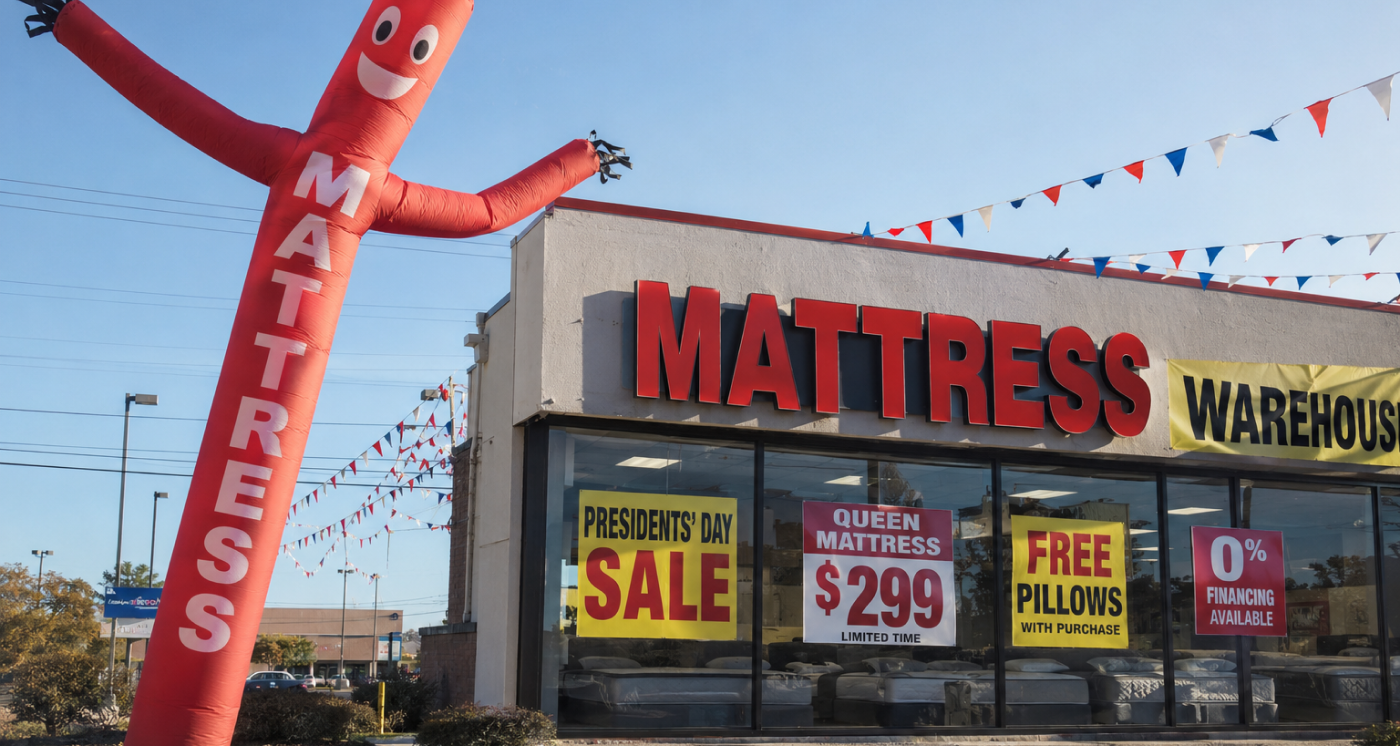
Walk into a mattress store on any given weekend and there's a good chance you'll encounter a sale.
Presidents' Day Sale. Memorial Day Sale. Labor Day Sale. Black Friday Sale. Anniversary Sale. Inventory Clearance Sale.
Somehow, the $2,499 mattress you were considering is now $1,299, and the salesperson assures you this is the lowest price they've offered all year.
It's a strange business. Customers buy the product once every seven to ten years, prices can be wildly confusing, and negotiating over something you're going to sleep on feels almost as awkward as negotiating over a used car.
But mattress retailing has a long history, and the industry's peculiar sales practices developed for reasons that make a surprising amount of economic sense.
For much of the 20th century, Americans bought mattresses from furniture stores and department stores. Dedicated mattress chains eventually carved out their own niche, with Sleepy's tracing its roots to New York in 1931 and Mattress Firm opening its first store in Houston in 1986.
Mattress Firm grew aggressively, buying regional competitors and eventually acquiring Sleepy's in 2016, adding more than 1,000 locations. By then, mattress stores had become fixtures of American strip malls, sometimes appearing on opposite corners of the same intersection.
The economics helped explain their proliferation. Mattresses are relatively expensive products that don't require much floor space, refrigeration, or large numbers of employees. A showroom might operate with just one or two salespeople, and a single transaction can generate substantial revenue.
Then there's the pricing.
Mattresses have historically carried substantial retail markups, giving stores room to advertise enormous discounts. Consumer Reports has documented retailers cutting advertised prices by 50% or more during holiday promotions. And because salespeople frequently work on commission, they have a financial incentive to steer shoppers toward more expensive models.
Manufacturers have also made comparison shopping remarkably difficult. A mattress sold under one model name at one retailer might have a nearly identical counterpart under another name somewhere else. That makes the classic promise to beat a competitor's price considerably less useful.
And when customers have no reliable way to determine what a mattress should cost, a 40% discount can look awfully persuasive.
The industry faced a major disruption in 2014 when Casper launched its mattress-in-a-box business. Soon, brands like Purple, Tuft & Needle, and Leesa were competing for customers online, offering simplified product selections, home delivery, and generous trial periods.
Their pitch appealed to anyone who'd ever spent a Saturday afternoon being followed around a showroom by a commissioned salesperson.
But the online revolution proved more complicated than expected.
Casper expanded into physical retail and wholesale distribution, eventually being acquired by foam manufacturer Carpenter Co. in 2024. Purple also embraced traditional stores, expanding its partnership with Mattress Firm in 2025. Apparently, even the companies trying to eliminate mattress showrooms discovered that customers sometimes prefer lying on a bed before spending $2,000 on it.
Meanwhile, the traditional giants have been consolidating.
In 2025, Tempur Sealy acquired Mattress Firm for roughly $5 billion, creating a combined company called Somnigroup International. As of June 2026, Mattress Firm operated approximately 2,155 company-owned locations. Other major players include Mattress Warehouse, regional independent chains, and Sleep Number, which entered Chapter 11 bankruptcy proceedings in June 2026 while pursuing a sale to Sleep Country Canada.
And despite everything that's changed, the mattress sale remains remarkably resilient.
The internet has made comparing prices easier, but mattress companies still compete heavily through promotions, financing offers, free accessories, and limited-time deals. Even online brands have adopted the holiday discount calendar.
Which means that somewhere in America right now, a salesperson is explaining that a $2,000 mattress has been reduced to $1,199.
And if you buy it today, they'll even throw in two pillows!