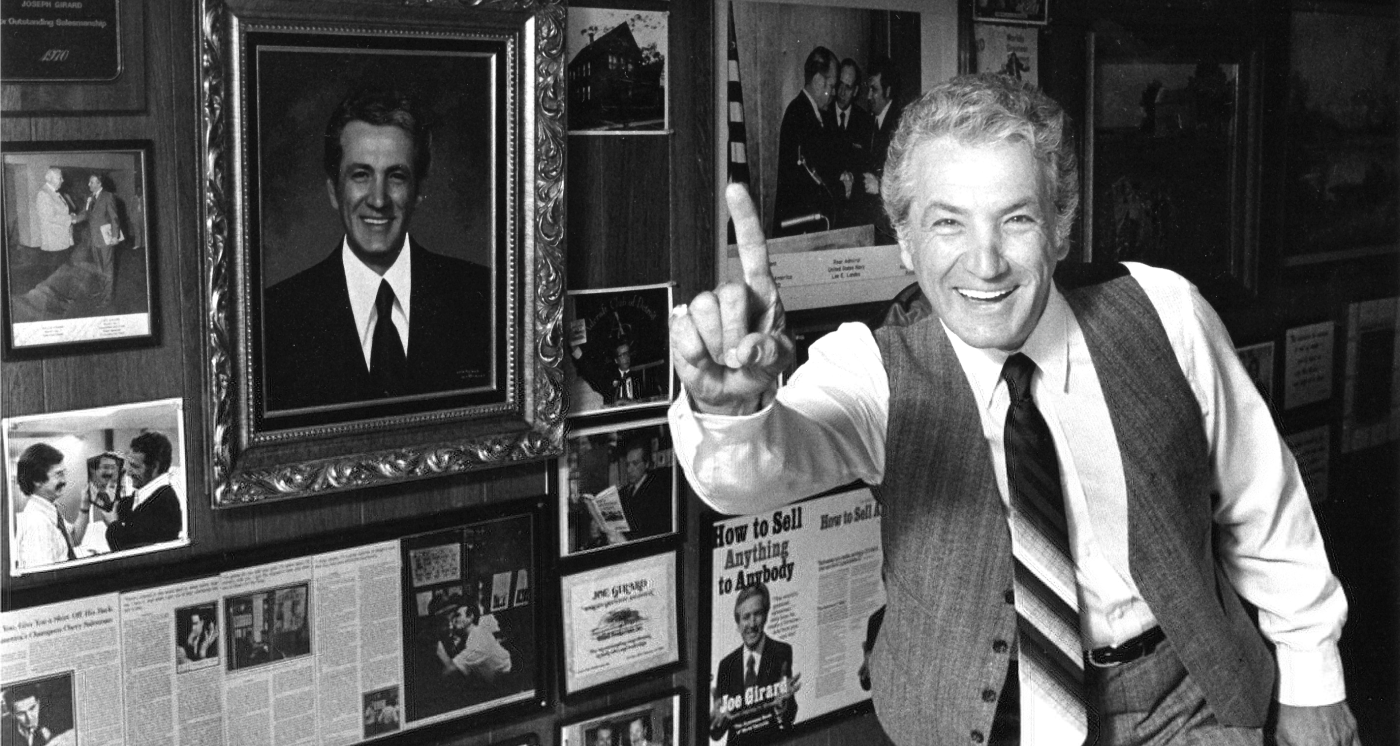
Joe Girard spent most of his working life selling Chevrolets in Detroit. For a period in the 1960s and early 1970s, he sold more cars than anyone ever had before.
In 1973, Girard sold 1,425 cars in a single year—retail transactions, not fleet deals—at Merollis Chevrolet. The Guinness World Records later recognized him as the highest-volume retail car salesman of all time.
Girard did not come into the job with a conventional background. Girard grew up in Detroit and left school early. He held a series of short-term jobs, such as shoeshining, construction, and delivery, before entering car sales in his mid-30s. By his own account, he arrived at the dealership with little financial cushion and no clear alternative.
The environment he entered was competitive and uneven. At the time, floor traffic was unpredictable, and access to serious buyers often depended on timing or internal politics. Most salespeople relied on walk-ins and whatever opportunities came their way.
Girard approached things differently. He focused on building a base of repeat customers and referrals, at a time when this was far from the norm, and he treated that effort as a daily discipline.
He maintained a large, organized file of past buyers and prospects. Each month, he sent them mail: birthday cards, holiday cards, or short notes with minimal messaging. One of his better-known lines was simply: “I like you,” (he must’ve read How to Win Friends and Influence People). At scale, this meant thousands of pieces of mail going out on a regular schedule.
His intent was to remain present, to stay fresh on the minds of people who had bought from him. When a customer or someone in their network needed a car, Girard’s name would be the first one that came to mind.
A significant portion of his sales came from that network. Buyers returned for additional purchases, referred friends and family, and asked for him directly at the dealership. In that sense, he reduced his dependence on chance foot traffic and replaced it with something more predictable.
On the showroom floor, his approach was attentive and controlled. He paid close attention to how customers entered, who asked questions, and how decisions were being made within a group. He kept notes on personal details and used them in later interactions.
Over a 15-year span, Girard sold more than 13,000 cars, which averages out to at least 2.37 cars per day, every day of the week, for fifteen years straight.
The system, however, required sustained effort. The volume of follow-up alone demanded time, organization, and consistency. It also depended on a willingness to keep personal and professional boundaries closely tied. Much of Girard’s contact with people was anchored in the expectation of a future transaction.
There were also practical limits to how easily his model could be reproduced. He operated in a high-demand market, during a period when car ownership was central to daily life and dealership traffic was relatively strong. His methods relied on physical mail, manual record-keeping, and a level of persistence that many salespeople did not (and still do not) maintain.
After leaving the dealership, Girard transitioned into speaking and training. He wrote books and presented his approach as a structured system built on follow-up and consistency.
His work reflected a specific view of sales: that sustained contact, applied methodically over time, could produce results at a scale that exceeded what most individuals achieved through one-time interactions.