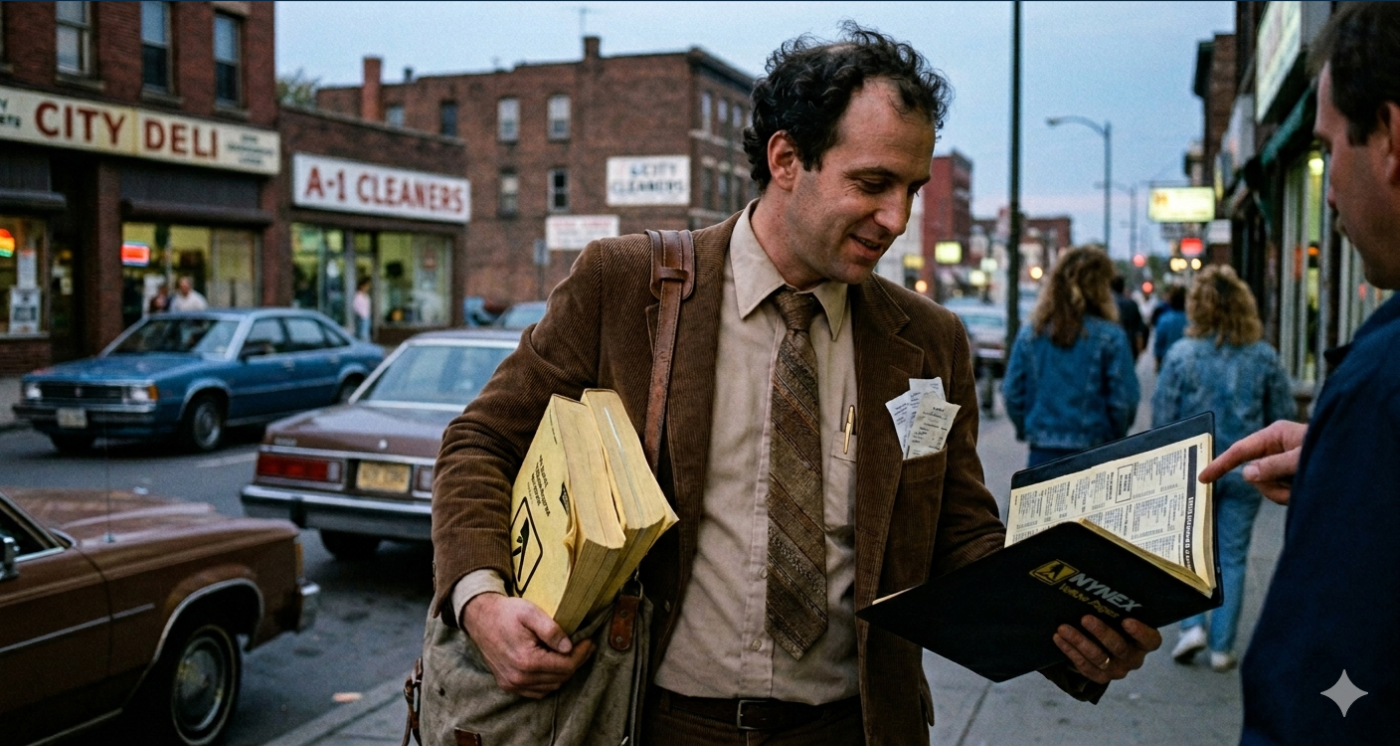
For most of the 20th century, if you wanted your phone to ring, you paid to be in the book.
The Yellow Pages started as a simple directory. In 1883, a printer in Wyoming ran out of white paper while producing a telephone directory and used yellow stock instead. The color stuck. By the early 1900s, phone books had split into two sections: white pages for residential listings, and yellow pages for businesses.
What began as a listing quickly became a valuable product. By the 1920s and 30s, local telephone companies—many of them part of the Bell System—realized they were sitting on something valuable. Every business needed visibility, and The Yellow Pages gave them a way to get it.
With the Pages success came a new kind of salesperson: the directory rep. They carried rate cards, mockups, and had a deep understanding of local markets. They walked into small businesses and made a straightforward pitch: when someone needs what you offer, this is where they look.
And for decades, that was true. By the 1950s and 60s, the Yellow Pages had become one of the most powerful advertising platforms in the country. Penetration was near total. Nearly every household had a directory, and when something broke or needed fixing, people flipped to the category and started calling.
By the 1970s and 80s, Yellow Pages sales had become a career. Large directories in major cities generated hundreds of millions in revenue. Top reps earned strong commissions and built long-term relationships with local businesses. Many operated with a high degree of autonomy. If you owned a territory with a dense business base, you could build a very good living.
Companies like AT&T and its regional operating companies controlled much of the inventory. Independent publishers also entered the market, especially after the breakup of the Bell System in 1984, which opened the door to more competition. Still, the core behavior held: when people needed something, they reached for the book.
The sales pitch (correctly) focused on the results. Reps would ask simple questions. How many calls did you get last month? How many jobs did you close? What’s one new customer worth to you? From there, the math followed. A larger ad, a better position, or a second category listing were each framed as a way to capture more of the demand that already existed.
And for many businesses, it worked quite well. For years, entire local economies ran through those pages.
The decline didn’t happen all at once. In the late 1990s, search engines started to change how people found information. Early on, the impact was easy to dismiss. Internet access wasn’t universal, and habits were slow to shift. Yellow Pages companies even launched their own online directories, assuming the brand would carry over. Both systems coexisted, at least for a while.
But the underlying behavior kept moving. By the mid-2000s, more consumers were searching online first. By the early 2010s, smartphones made that shift constant. Instead of flipping to a category and calling down the list, people typed a query and chose from a set of results that changed in real time.
By then, the annual print cycle had become a financial liability and the fixed placement that once created scarcity now felt rigid.
Major publishers saw steep declines. Some consolidated, while others filed for bankruptcy. Dex Media, once one of the largest directory publishers, went through multiple restructurings.
Predictably, the sales role changed with it. Reps who had spent years selling print ads were asked to sell digital packages—search listings, website services, bundled marketing products. Some adapted, but many didn’t. The product was different, the pitch was different, there was more competition, and the certainty that came with the old model was gone.
The Yellow Pages still exists, but is a mere fraction of the search behemoth it once was. But, as every good sales person knows, nothing lasts forever.