By the 1970s, the U.S. vacation market was ready for something new. Air travel was getting cheaper, the middle class had more disposable income, and places like Florida and Hawaii were booming. Developers had inventory to fill and a simple question to answer: how do you turn a one-time guest into a lifetime customer?
The answer became the modern timeshare.
Early U.S. projects took shape in Florida. One of the first widely recognized developments was Vacation Villas at FantasyWorld near Orlando, opened in the early 1970s. Instead of purchasing a home, buyers purchased a specific week, every year, in a specific unit. It felt tangible. Or tangible enough, anyway.
From there, the industry scaled fast. By the late 70s and 80s, a mix of independent developers and emerging hospitality players were all-in. Companies like Resort Condominiums International (RCI) helped unlock growth by creating exchange networks, allowing owners to trade their week for time at other resorts. This solved one of the early friction points: being locked into the same place forever.
Big brands followed. Marriott launched Marriott Vacation Club in 1984. Hilton and Disney would enter later, but the groundwork was laid in the 80s, when the category proved it could generate serious revenue.
But what really drove that growth was the sales model.
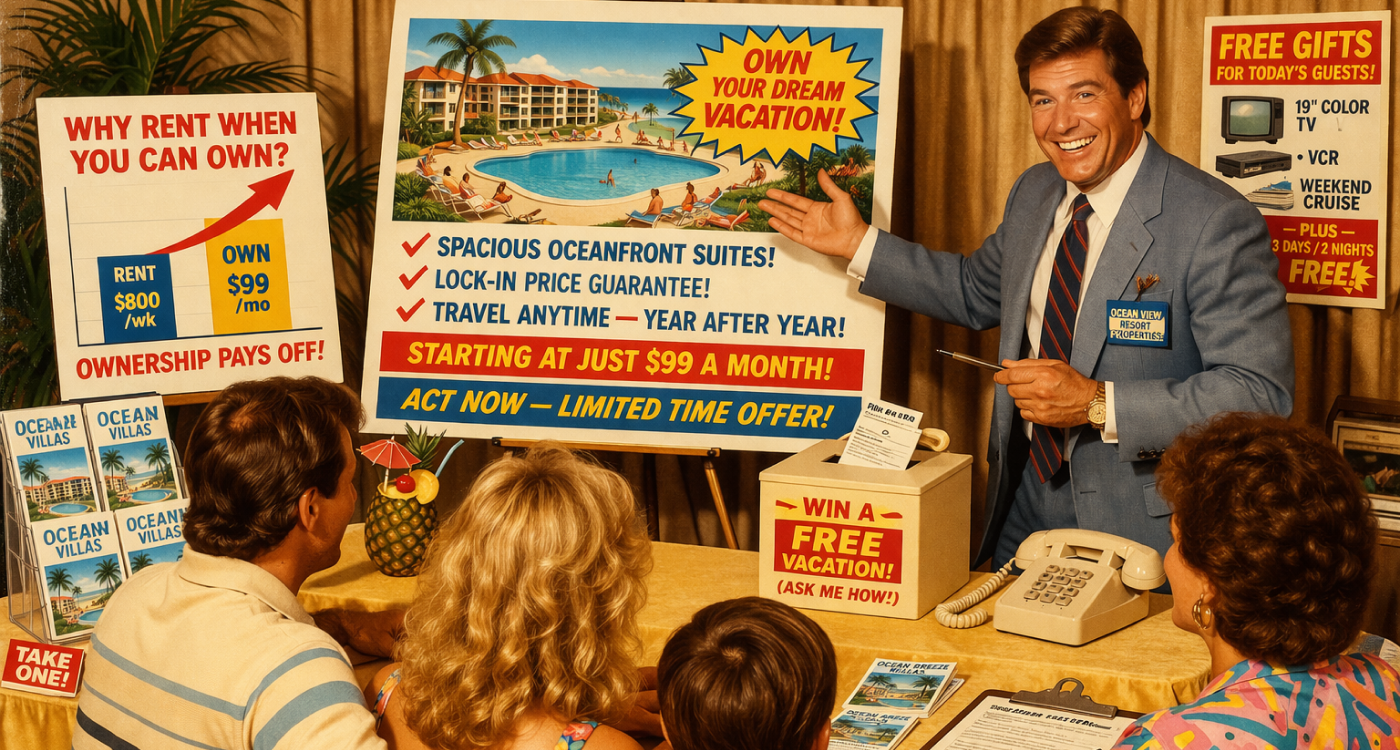
The entry point was almost always an incentive. Free show tickets to Las Vegas. Discounted stays in Orlando. Or maybe a complimentary dinner. The offers felt low-stakes. But once you accepted, you were scheduled into a presentation.
Those presentations were engineered environments. They ran long—often 90 minutes or more—and took place on-site, inside or near the resort.
Sales reps were trained to anchor everything to what you already spent. A family taking one or two vacations a year might spend a few thousand dollars annually. Over ten or twenty years, that number became the comparison point. The timeshare price was framed against that total, not against other purchases you might make today.
There were also structured handoffs. If a buyer hesitated, a second or third rep—often labeled a “manager”—would step in. They brought new energy, new framing, and sometimes a “one-time” adjustment to price or terms, of course. The goal was to keep the momentum (pressure) going without giving the buyer space to reset.
Urgency was constant. Reps highlighted specific weeks, specific units, and limited availability. If you were shown a July slot, you were told it might not be there tomorrow. Walking out supposedly meant you were giving something up.
Some companies became known for how tightly they ran this process. Westgate Resorts, founded by David Siegel in 1982, built a massive business in Orlando using high-volume tours and aggressive closing tactics. In Las Vegas, firms tied to casino operators used similar playbooks, bundling timeshare pitches with entertainment packages to keep prospects engaged.
This system worked at scale. By the late 80s, timeshares were a mainstream product, and the sales floor became one of the most systematized closing environments in business.
What happened next was predictable.
As more buyers came in, more complaints followed. Maintenance fees increased over time. And reselling a timeshare proved difficult. Some owners realized they had far less flexibility than they expected. State regulators stepped in, adding cooling-off periods and stricter disclosure requirements. The industry didn’t completely disappear, but it was seriously hobbled.
Over time, the model shifted from fixed weeks to points-based systems. Instead of owning the second week of July in one unit, you owned points you could use across multiple properties. This change addressed flexibility, which was one of the biggest objections from earlier buyers.
Today, the major players look different from the scrappy operators of the 70s and 80s. Marriott Vacations Worldwide, Hilton Grand Vacations, and Wyndham Destinations (now Travel + Leisure Co.) dominate the space. The sales presentation still exists, and incentives still bring people into the presentation room—but the tone is more controlled. Digital marketing now feeds the funnel alongside the traditional “free vacation” hook.
What made the industry explode in the first place was the combination of timing and execution. Americans wanted predictable, repeatable escapes. Developers had inventory to fill. Sales teams built a process that turned interest into commitment before second thoughts could take over. Everything else came after.