In the early 1900s, vacuum cleaners were still a novelty. They were bulky, expensive machines that most people had never seen in person. Stores didn’t stock many of them, and advertisements alone couldn’t explain why someone should spend serious money on a machine meant to clean carpets.
So companies took a different approach. They sent salesmen directly to people’s homes.
One of the most successful companies to build its business this way was the Kirby Company, founded in Cleveland in 1914 by inventor James B. Kirby. Kirby designed durable vacuum cleaners made largely of metal, built to last for decades. They were powerful, versatile machines—but also expensive. A Kirby vacuum could cost several hundred dollars in an era when that represented a major household purchase.
Retail shelves weren’t the right environment for a product like that. Customers needed to see what the machine could actually do.
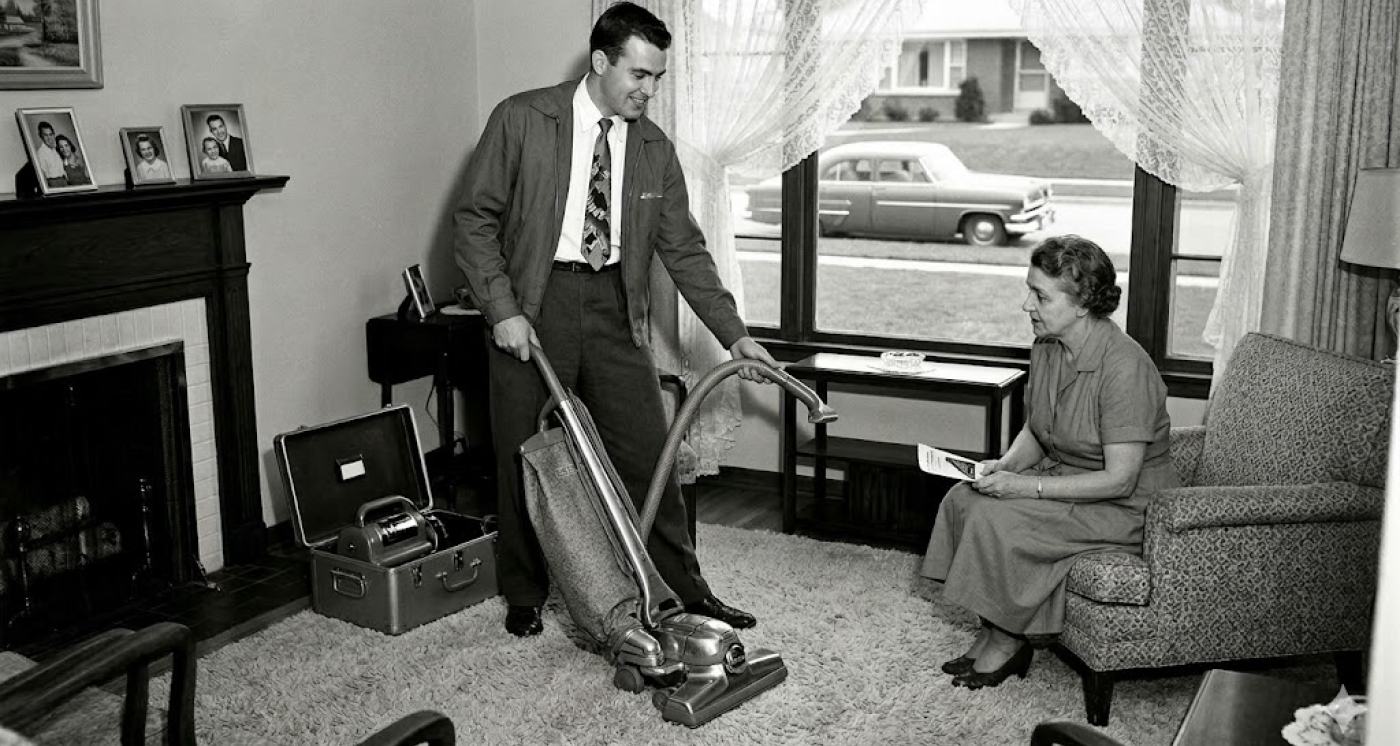
Door-to-door demonstrations became the solution. Salespeople would carry the heavy machines from house to house, knocking on doors and asking homeowners if they could show them a new cleaning system. If someone agreed, the demonstration began right there in the living room. The method was simple but incredibly effective.
First, the salesperson would vacuum a patch of carpet using the homeowner’s existing vacuum cleaner or sweep the area to show it was already clean. Then they would run the Kirby over the same section and attach a filter bag designed to catch extremely fine dust. When the bag filled with gray powder, the message was unmistakable: the carpet wasn’t nearly as clean as the homeowner thought.
For many people, this was the first time they had seen what was actually trapped inside their floors. The demonstration turned an abstract product into a visible problem—and a visible solution.
This kind of selling wasn’t unique to Kirby. During the early and mid-20th century, door-to-door sales became one of the most powerful distribution models in the United States. Products like encyclopedias, brushes, cookware, and vacuum cleaners spread across the country through traveling salespeople who built relationships with customers face-to-face.
But vacuums were especially suited to this method. A vacuum cleaner’s value was hard to communicate with words alone. Demonstration made the difference obvious within minutes. Once homeowners saw the amount of dust pulled from their carpets, many felt embarrassed about the condition of their homes. After that, the salesperson didn’t need a complicated pitch.
Another reason the system worked was geography. In the decades after World War II, suburban neighborhoods expanded rapidly across the United States. Rows of houses filled with young families created ideal territory for door-to-door sales. A determined salesperson could walk an entire street in an afternoon and potentially find multiple customers.
Companies like Kirby trained their salespeople to treat each home as a performance. Demonstrations could last an hour or longer. Reps showed attachments that cleaned upholstery, mattresses, drapes, and even polished floors. The goal was to position the machine as a long-term household investment rather than a simple appliance.
Many young salespeople were drawn to the job because a single successful sale could produce more income than several days of hourly work. That promise created a culture of persistence. Rejection was constant—most doors never opened—but experienced reps learned that success came from knocking on enough doors.
Over time, retail chains and appliance stores began to dominate the vacuum market. Door-to-door selling declined across many industries as shopping habits changed. But the model never fully disappeared.
The Kirby Company still sells vacuums today using in-home demonstrations, more than a century after the company was founded. The machines remain expensive and durable, and the company still believes the best way to sell them is to show them working inside someone’s home.
The strategy reflects a simple lesson that modern sales teams still use: people believe what they can see. For decades, a knock on the door and a strip of freshly vacuumed carpet were enough to prove the point.