Imagine walking into a store, telling a salesperson you'd like to spend $15,000 on a watch, and being politely informed that you can't buy one.
But it’s not because your credit card was declined. It’s because the store doesn't consider you an important enough customer yet.
Welcome to the strange world of luxury watch sales, where getting someone to take your money can be surprisingly difficult.
The modern luxury watch industry owes much of its success to Rolex, founded in London in 1905 by Hans Wilsdorf. At the time, pocket watches were still popular, and wristwatches were considered relatively delicate accessories.
Wilsdorf helped change that perception. In 1926, Rolex introduced the Oyster, a waterproof wristwatch. The following year, British swimmer Mercedes Gleitze wore one during an English Channel swim, providing Rolex with a spectacular publicity opportunity. The company ran a full-page newspaper advertisement celebrating the achievement.
Over the following decades, luxury watchmakers associated their products with explorers, athletes, pilots, and celebrities. Rolex, Omega, Patek Philippe, and Audemars Piguet became symbols of achievement and wealth, with certain models developing devoted followings.
Today, selling these watches involves some unusual rules.
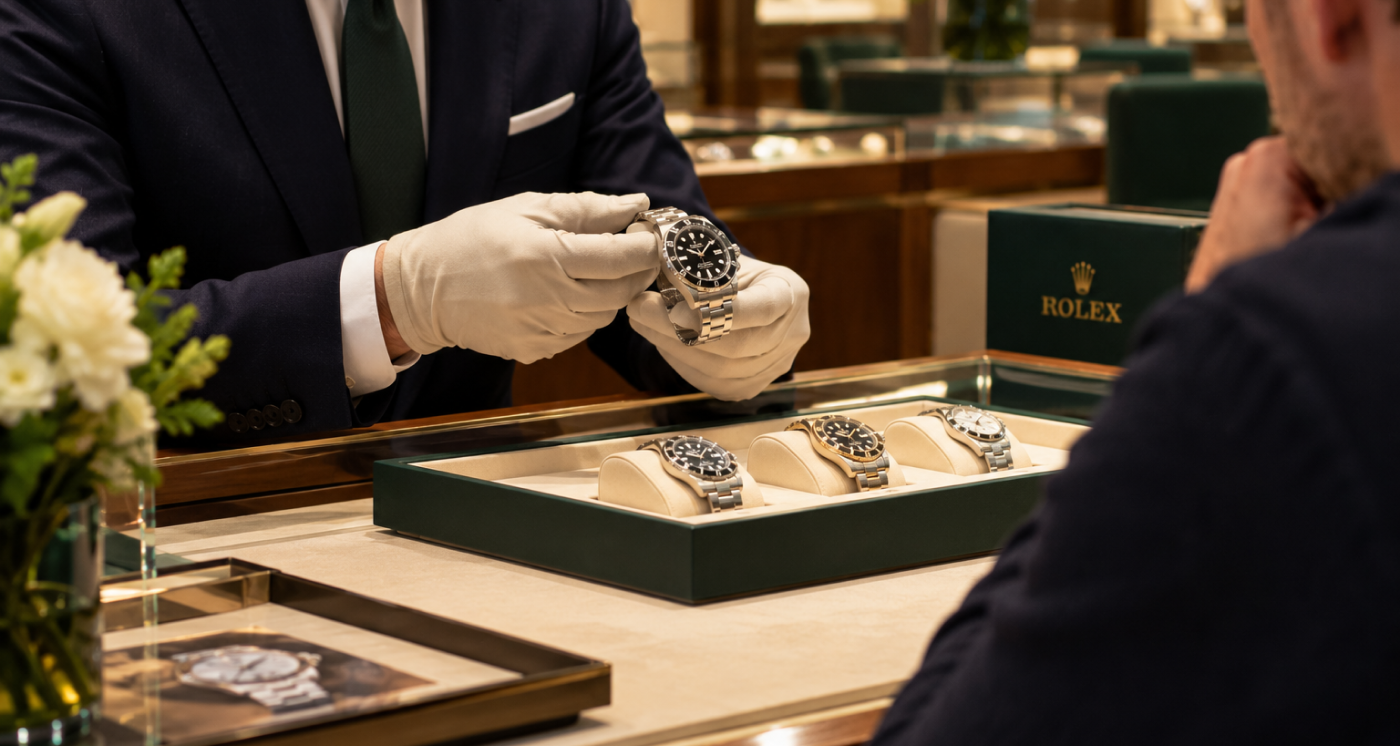
Most Rolex watches are sold through authorized dealers, independent retailers approved by the manufacturer. Dealers receive allocations of particular models, and highly desirable watches can be extremely difficult to obtain.
Walk into a dealership asking for a stainless-steel Rolex Daytona, for example, and you're unlikely to leave with one.
Sales associates often maintain lists of interested customers, although these aren't necessarily traditional first-come, first-served waiting lists. Purchase history, existing relationships, and a dealer's assessment of the customer can all influence who gets offered a coveted watch.
This creates an unusual sales dynamic. Customers sometimes purchase less desirable watches or jewelry to establish relationships with dealers, hoping to improve their chances of eventually acquiring the model they actually want.
Of course, there's no guarantee that spending $20,000 on other merchandise will get you the Rolex you've been chasing.
The economics help explain the behavior. Certain watches have historically traded on the secondary market for considerably more than their official retail prices. Dealers have an incentive to avoid selling scarce inventory to customers who immediately flip it for a profit.
For salespeople, relationship management becomes particularly important. They need to recognize serious collectors, cultivate repeat buyers, understand complicated product histories, and navigate customers who may have more money than patience.
And the actual sales experience can be remarkably elaborate. Luxury boutiques offer private appointments, champagne, personalized service, and detailed presentations about movements, materials, and craftsmanship.
A customer spending $40,000 on a watch generally expects a little more attention than someone buying a Casio at Target.
The industry has also developed a massive secondary market, with independent dealers buying, selling, and trading watches that may appreciate or depreciate dramatically. In 2022, Rolex entered this business directly with its Certified Pre-Owned program, allowing participating authorized retailers to sell authenticated secondhand watches.
Meanwhile, the broader Swiss watch industry has faced a slowdown. Swiss watch exports fell to 25.6 billion francs in 2025, a 1.7% decline from the previous year, even as demand remained comparatively resilient at the highest end of the market.
For luxury watch salespeople, the challenge is balancing exclusivity with customer relationships in an industry where supply, status, and personal connections can matter as much as the product itself.
And for the customer who just wants to buy a Daytona?
Perhaps start by introducing yourself. And don't expect to leave wearing one.