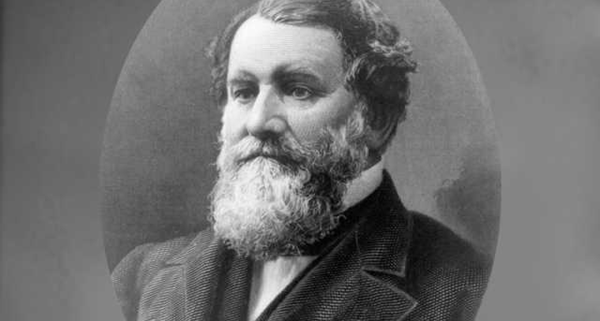
The farmers gathered around the muddy Virginia field in July 1831, arms crossed, skepticism written across their faces. Twenty-two-year-old Cyrus McCormick wheeled his ungainly horse-drawn machine toward six acres of ripe oats. One observer later described it as "a cross between a wheelbarrow, a chariot, and a flying machine." What he had created was a mechanical reaper.
The stakes were high. His family's iron foundry had failed in the wake of the 1837 financial panic. This reaper was their last shot at solvency. The horses pulled. The blades whirred. In one afternoon, the contraption cut through what would have taken a dozen men with scythes an entire day to harvest.
McCormick had solved an engineering problem. What he hadn't solved was the sales problem. For the next decade, he sold less than 100 reapers.
Then McCormick did something that would reshape American commerce. He built a sales machine. In 1847, McCormick relocated to Chicago, then a swampy town of 17,000. The railroad wouldn't arrive for three years. The telegraph hadn't reached the city. He was betting on infrastructure that didn't yet exist.
What he built there would define field sales for the next century.
Building the Machine
McCormick's innovation wasn't the reaper itself. Dozens of inventors had created working models by the 1830s. Scottish farmer Patrick Bell had built a successful harvester years before McCormick's first demonstration.
McCormick's breakthrough was understanding that revolutionary products don't sell themselves. Farmers needed to see the reaper work in their fields. They needed someone local who could repair it mid-harvest. They needed credit terms matching their cash flow.
So McCormick built a distributed sales organization unlike anything that existed in 1840s America.
He recruited local merchants as exclusive territorial agents. McCormick's agents set up shop in designated territories, received sample machines, and took commissions on sales. They demonstrated the reaper in actual field conditions, arranged financing, delivered machines, and provided repair service during harvest season.
At its peak, the McCormick Harvesting Machine Company had around 5,000 third-party sales agents in the field. Each agent was trained on machine mechanics, business practices, and customer service. Each had an exclusive territory, and each was motivated by commission.
The Playbook Emerges
The organizational structure McCormick built reads like a modern sales ops manual. He established regional performance expectations and used "traveling agents" to monitor distributor activity. He created feedback loops through correspondence and a company-published trade magazine.
He trained agents on economics. The reaper cost $125 in the early 1850s (roughly $3,800 today). His agents learned to articulate ROI, demonstrating how the machine would replace eight to ten field workers within a season.
He pioneered customer financing, offering installment plans with payments stretched between harvests. "It is better that I should wait for the money than that you should wait for the machine," he said. He standardized pricing.
His motto: "One Price to All." While competitors haggled, McCormick eliminated the friction of negotiation.
McCormick offered performance warranties and fast after-sale service. A satisfied customer became a testimonial, which he liberally used in advertising.
The System Scales
By 1850, McCormick was selling 5,000 reapers annually. By 1868, production exceeded 9,500 machines. The Chicago facility had become the largest factory in the city.
In the 1880s, McCormick replaced commission-based regional agents with salaried managers who oversaw franchised dealers. The move from independent contractors to a controlled distribution model anticipated shifts many modern companies make as they mature.
When Cyrus McCormick died in 1884, his son continued expanding. By the early 1900s, McCormick had 65 regional offices across the United States, six in Canada, and international offices. In 1902, the company merged with competitors to form International Harvester.
The Legacy Lives in Every Sales Org
McCormick understood something fundamental: distribution is as important as invention. A revolutionary product without systematic distribution dies in obscurity. A competent product backed by excellent distribution builds empires.
He proved that sales could be engineered, systematized, and scaled. If you trained people properly, gave them the right incentives, supported them with the right tools, and held them accountable to defined territories and performance expectations, they'd build customer relationships that compound over time.
The reaper transformed agriculture. McCormick's sales machine transformed commerce. 170 years before CRMs, before formal sales methodologies, before revenue operations, he built a distributed, commission-based, demo-driven sales organization that sold complex capital equipment to skeptical buyers across a continental market.